edited by Bianca Maria Antolini, 2000
Edizioni ETS
Piazza Carrara 16–19, 56126 Pisa
tel. 050.29544; 503868 fax 050.20158
e-mail: edizioniets@tin.it
Scientific Committee
Bianca Maria Antolini, Alberto Basso, Jeffrey Kurtzman, François Lesure, Agostina Zecca Laterza, Agostino Ziino
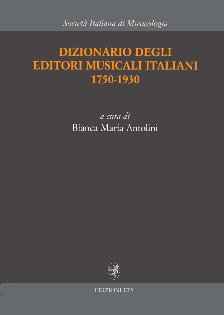
Research into publishing and the book trade has now become a new and fruitful field within cultural history, and in music too the study of publishing history is proving essential for understanding and clarifying the ways in which music has been produced, disseminated, circulated and received. As a basis for any further reflection, it is therefore necessary to have an overall picture of the history of music publishing houses active in different periods and places. Precisely in response to this need, the Società Italiana di Musicologia, with the support of the Consiglio Nazionale delle Ricerche (CNR), promoted a research project involving around thirty Italian and international scholars, aimed at producing a Dictionary of Italian Music Publishers. The first outcome of this project is the present volume, which covers the period 1750–1930, a period that has been virtually ignored—apart from a few exceptions—by studies of Italian music publishing, which have so far focused mainly on the major publishers of the sixteenth century.
The polycentric nature of Italian history made it necessary to conduct research across a range of local contexts: in fact, the sources for this study, for the most part previously unknown or unused, are preserved in the archives and libraries of many Italian cities, as well as in the Central State Archives. In order to reconstruct the activity of the various publishing houses, the research drew on archival documents (publishing privileges, patents, licences, deposit lists, declarations of ownership, records of legal disputes, commercial documents, correspondence between authors and publishers), both specialist and general newspapers and periodicals, commercial guides and yearbooks from various cities, musical yearbooks, publishers’ catalogues, the Bibliografia nazionale italiana, and more besides. In addition, the SBN Musica database made it easier to verify surviving printed copies directly and thus to examine Italian music publishing production in greater detail.
The Dictionary contains approximately 400 alphabetically arranged entries on publishers, printers and music booksellers active in Italy between 1750 and 1930. In characterizing each publisher’s activity, attention is given to the type of business involved (publishing and/or bookselling), the different stages in the history of the firm (changes of premises, acquisitions or mergers with other firms, publishing privileges, agreements with other publishers, and so forth), as well as to the particular features of the musical repertory it issued, its relations with composers, the issue of reprints and counterfeits, the role of patrons and institutions, and the commercial strategies used to distribute its publications. Adequate space is devoted to the technical aspects of music printing; for those publishers who used plate numbers, the numerical series are reproduced together with a proposed dating scheme. Finally, the entries also bring out the links with other activities, both in the book trade—musical and otherwise—and in musical life as a whole. One need only consider, for example, the relationship between publishers and theatrical copyists in the early nineteenth century, or that between music publishing and theatrical entrepreneurship in the second half of the century. Each entry concludes with a list of sources and a bibliography.
The volume opens with a substantial historical introduction. A series of geographical and chronological tables, a rich iconographic section—including reproductions of illustrated title pages, covers, some in colour, and examples of the various printing techniques employed—and an index of names complete the book.
The Dictionary thus offers a wide-ranging picture of Italian music publishing, considered in its many relationships with musical activity at large. It is intended as a fundamental research tool for musicologists, librarians and bibliographers, both musical and non-musical, standing alongside comparable international initiatives—among them the recent Dictionnaire des éditeurs de musique français, edited by A. Devriès and F. Lesure—in providing a scientifically sound and fully documented account of an important part of European music publishing.