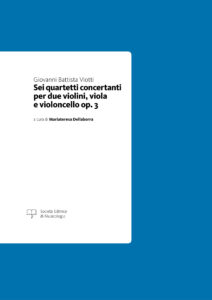
edited by Mariateresa Dellaborra (Instrumental Music, 15)
1 January 2025
Giovanni Battista Viotti’s Op. 3, published by the Parisian publisher Sieber between 1782 and 1786 and reissued by Leduc at the beginning of the nineteenth century, makes a significant contribution to the quatuor concertant form. Compared with Op. 1, of which it represents the ideal second part, the six quartets it comprises are enriched by virtuoso elements, making them an interesting testing ground for professional performers, and they favour a three-movement structure (Quartets 2, 4, 5 and 6) rather than a two-movement one (1 and 3). Although they show the influence of Haydn, especially evident in the opening movements, the quartets reveal Viotti’s distinctive voice, apparent not only in their thematic choices but also in their harmonic handling and the solidity of their formal design.
Mariateresa Dellaborra’s research focuses primarily on Italian music between the eighteenth and nineteenth centuries. She has published books and essays with Olschki, ETS, Brepols, L’epos, LIM, Ut Orpheus, Rugginenti and Marsilio; contributed numerous entries to The New Grove (2nd edition) and MGG; and edited critical editions of instrumental works (N. Paganini, G. B. Viotti, A. Rolla, S. Mercadante) and operas (G. B. Sammartini, N. Traetta, N. Jommelli, M. Portugal da Fonseca, A. Stradella). She is a member of the Scientific Committee of the Fondazione Arcadia (Milan) and is responsible for the Monumenti Musicali Italiani series of the Società Italiana di Musicologia. She is also part of the ITMI working group (Indici della Trattatistica Musicale Italiana), at the Fondazione Franceschini in Florence. She teaches Music History at the “Nicolini” Conservatory in Piacenza.